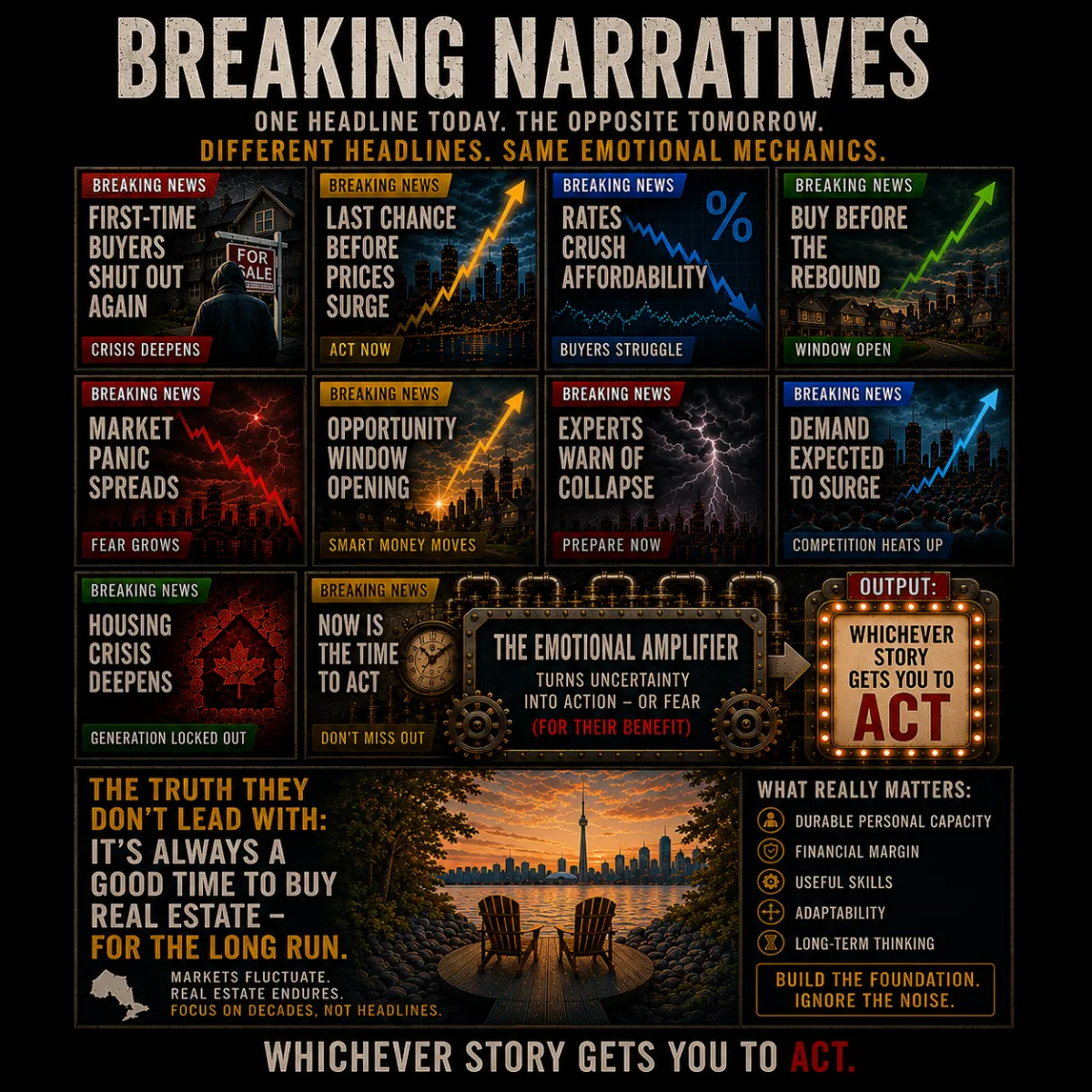
Breaking Narratives
Most people are asking the wrong question about the housing market.
Every time interest rates move, tariffs appear, inflation rises, elections approach, or global instability makes headlines, the same question immediately follows:
“How will this affect the housing market?”
The question appears constantly on social media, in news interviews, in market updates, and increasingly, in polished short-form content designed to reassure nervous buyers that now — once again — is or is not the right time to act.
Sometimes the message is optimistic.
Sometimes urgent.
Sometimes subtle.
Sometimes wrapped in concern.
But the underlying structure is almost always the same:
An external event occurs.
A consumer becomes uncertain.
Someone immediately reframes the uncertainty into a reason to transact or flee.
The Mechanics of Urgency
Anyone who has spent enough time in sales develops an uncomfortable awareness of how frequently the same emotional triggers appear in completely different industries.
Fear of missing out is one of the oldest and most reliable mechanisms in modern marketing. Sometimes it appears as scarcity. Sometimes urgency. Sometimes fear. Sometimes opportunity wrapped in optimism.
“Buy now before rates rise.”
“Act before prices increase.”
“Don’t miss this window.”
“Limited-time offer.”
“Your financial future may be at risk.”
Different products. Same mechanics.
The objective is rarely long-term reflection. The objective is emotional compression. Compress the decision window tightly enough and people become more likely to act before fully evaluating the durability of the decision itself.
To be fair, I’m hardly claiming immunity here. Anyone who has worked professionally in sales understands these mechanics because we’ve all used versions of them at one point or another. Once you understand how urgency framing works, you start seeing it everywhere.
Now you will too.
From real estate headlines to cybersecurity ads warning that your information may already be floating around the dark web — and that, fortunately, they can help protect you from this terrifying development for a conveniently priced monthly subscription fee — the underlying pattern remains remarkably consistent.
The problem is not that these mechanisms exist, but what happens when short-term emotional pressure begins influencing decisions intended to survive decades.
The Wrong Question
This is also where a great deal of modern housing commentary quietly breaks down.
Turn on almost any financial segment, housing panel, short-form real estate clip, or market interview and the discussion usually revolves around the same narrow set of external variables:
Interest rates.
Tariffs.
Inflation.
Elections.
Market fluctuations.
Economic uncertainty.
The underlying assumption is almost always the same: that these external events are what ultimately determine whether ownership succeeds or fails.
But if a quarter-point interest rate movement, a tariff announcement, a temporary market fluctuation, or a negative news cycle immediately places the entire ownership decision into question, the issue may not be the external event itself.
The issue may be that the purchase structure was already too fragile for long-term ownership.
These assumptions did not appear out of nowhere.
Part of the issue may be that large sections of modern society still operate on assumptions inherited from the industrial era itself.
For generations, stability was closely tied to institutions. Large employers, long-term careers, pension structures, and predictable corporate ladders created the expectation that remaining employable inside the system was itself the path to long-term security.
Even many modern business programs still primarily train students to manage systems and operate within existing institutional frameworks rather than develop adaptable independent market value.
Meanwhile, technological disruption, automation, rising living costs, and rapidly shifting industries are eroding many of the very structures people were taught to depend on.
None of this is an argument against real estate itself.
Real estate has historically created wealth over time. Equity accumulation, principal reduction, appreciation, and leverage have all improved financial outcomes for many people over multiple decades.
But somewhere along the way, a dangerous simplification began creeping into the public conversation:
That real estate itself is the strategy.
It isn’t.
Real estate is a vehicle. A tool. Sometimes an excellent one. But sustainable ownership still depends on something far less exciting and far less marketable: durable personal capacity.
Useful skills.
Adaptability.
Financial margin.
Long-term thinking.
The ability to withstand normal economic fluctuations without emotional collapse.
The irony is that buyers who approach ownership from that position are often largely unaffected by short-term market noise. Temporary rate increases, headline volatility, and monthly prediction cycles are reduced to background static rather than existential events.
Stop Looking Out. Start Looking In.
The market did not suddenly become hostile to one person and friendly to another overnight. The difference was structural long before the external event occurred.
Ironically, real estate’s long-term success has encouraged increasingly short-term thinking.
The issue is not ownership, but fragile ownership structures built on urgency, thin margin, emotional compression, and the assumption that external conditions must remain permanently favorable.
Which brings us back to the original question:
“How will this external event affect the housing market?”
Parting Shot
For many buyers, the better question may simply be:
“How durable is the life supporting the purchase?”
Matt Cooper
Owner | Broker of Record
Durham Home Key Realty
